

The evidence base for timber construction in social housing
Five years of research, tools, and verified data. Everything developed within the HOME for the future project is available here, free to download and use. Whether you arrived looking for one specific resource or want to understand the full picture, this is where the work lives.
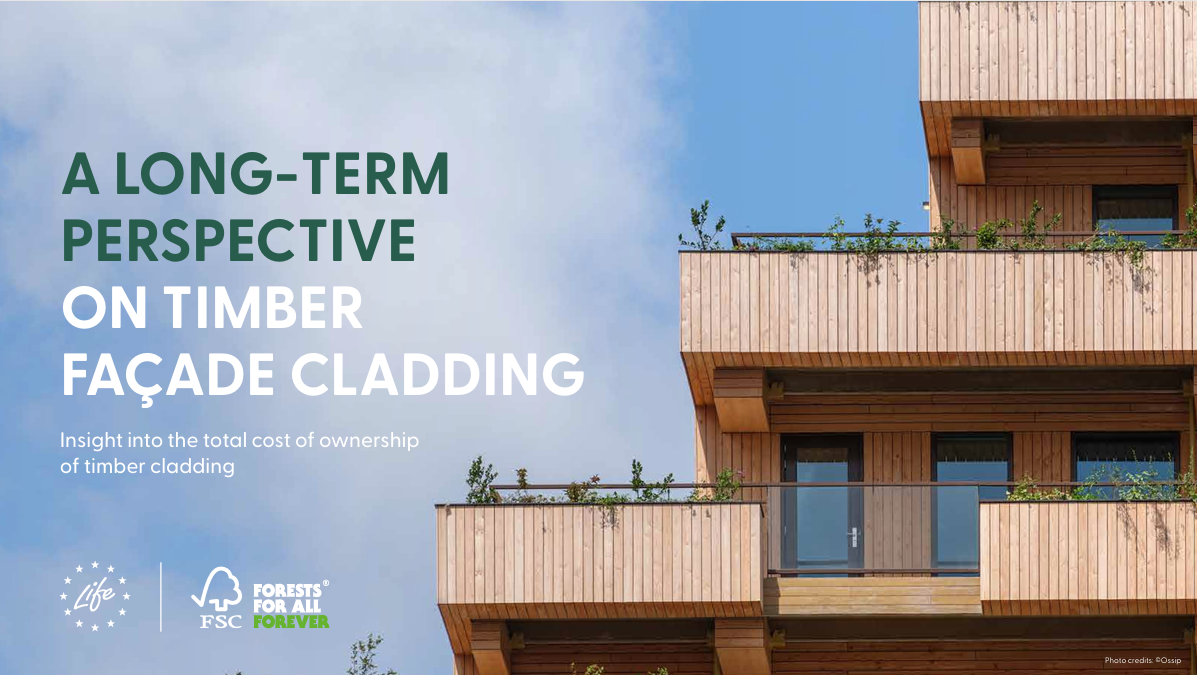
A long-term perspective on timber façade cladding
-
Timber facades are gaining ground, but they still raise questions for many clients. How much maintenance does it need, how long will it last, and what does that mean for the long-term maintenance budget.
In practice those questions often get answered with an assumption or the experience from a previous project. Understandable, but risky. This publication puts figures on the table instead. Four widely used types of timber facade cladding are compared over forty years, based on real data from housing associations.
The outcome is nuanced. It is not the lowest price per m², but the number of replacement moments that ultimately determines what a facade costs. A cheap softwood facade you replace twice is more expensive than a tropical hardwood facade that stays up for forty years. Price per m² and real cost do not always point the same way. This whitepaper puts them side by side, based on figures from the daily practice of housing associations, so you can see where the costs really sit.
-
This publication was produced by FSC Netherlands, within the European LIFE project HOME for the future. It grew out of questions that housing associations raised again and again during courses and knowledge sessions on building with timber. The TCO analysis draws on recognised standards, practical guidelines and field data from the sector, with contributions from timber merchants, knowledge partners and housing associations, and a sounding board including TBI, Houtbouw Lente and wrk architecten. This is part 1. Part 2, planned for 2027, adds environmental impact through a true price approach, the full cost price including material and environmental effects.
Insights into the total cost of ownership of timber cladding

Dual LCA for Buildings
The climate case for certified timber, quantified.
-
The absence of certified timber sourcing adds 4.5 to 5.7 kg CO₂e per square metre, per year to a building's climate impact. For two of the three projects studied, that difference alone determines whether the building meets or exceeds the Danish legislative limit value for new residential construction of 12 kg CO₂e/m²/year. The source of the timber is not a procurement preference. It is a compliance variable.
This report, produced by Søren Jensen Engineering, introduces a dual LCA method that simultaneously addresses two design questions: what is the climate impact of the building if timber structural elements are designed for reuse and biogenic carbon release is postponed, and what is the climate impact according to the standard BR18 benchmark? Using both methods together forces material optimisation alongside carbon performance. Neither method alone is sufficient.
The reuse potential of timber structural elements, inner walls, and wood-based materials was calculated at 2.9 to 4.2 kg CO₂e/m²/year, the single largest positive contribution in the entire assessment. Designing for disassembly is not an end-of-life consideration. It is a carbon strategy.
With whole-life carbon disclosure becoming mandatory across the EU in 2028, this methodology gives design teams a practical tool for making material decisions before they become compliance problems.
-
Produced by Søren Jensen Engineering, an independent structural and mechanical engineering firm, in conjunction with and funded by the HOME for the future project. The dual LCA method was tested on three residential timber buildings, one single-family house and two multi-storey residential buildings, at different stages of completion. One project was specifically designed using the dual LCA method from the outset.
How to minimise upfront carbon emissions without overspending materials, tested on three residential timber projects.
Report and infographic by Søren Jensen Engineering
Dual LCA for Buildings
Infographic.
The key findings of the Dual LCA report in visual form.
-
The infographic covers four arguments that the full report makes, translated into accessible visuals for use in project conversations and team briefings.
First, it shows the lifecycle stages of a building according to EN 15978 and which modules most LCA methods actually include in practice. Second, it visualises the distribution of climate impact between production and end-of-life across different material types, showing timber as the only material type with a potential negative contribution at the start of its lifecycle. Third, it explains the dual LCA method: why two methods must be used together to avoid optimising for carbon at the expense of material efficiency. Fourth, it shows the compliance consequence of uncertified timber: an increase of 4.5 to 5.7 kg CO₂e/m²/year that pushes two of the three case projects above the Danish legislative limit value of 12 kg CO₂e/m²/year.
The central conclusion is stated directly: sequestered biogenic carbon can only be included as a negative contribution in LCA calculations if the timber originates from a sustainably managed, certified forest. Sourcing is not a procurement preference. It is a calculation variable.
-
Produced by Søren Jensen Engineering in conjunction with and funded by the HOME for the future project. The infographic accompanies the full Dual LCA for Buildings report and is based on the same three residential timber case projects. It was developed to make the methodology and findings accessible to project teams, sustainability advisors, and decision-makers who need the argument without the full technical report.
Construction Stored Carbon Factsheet
-
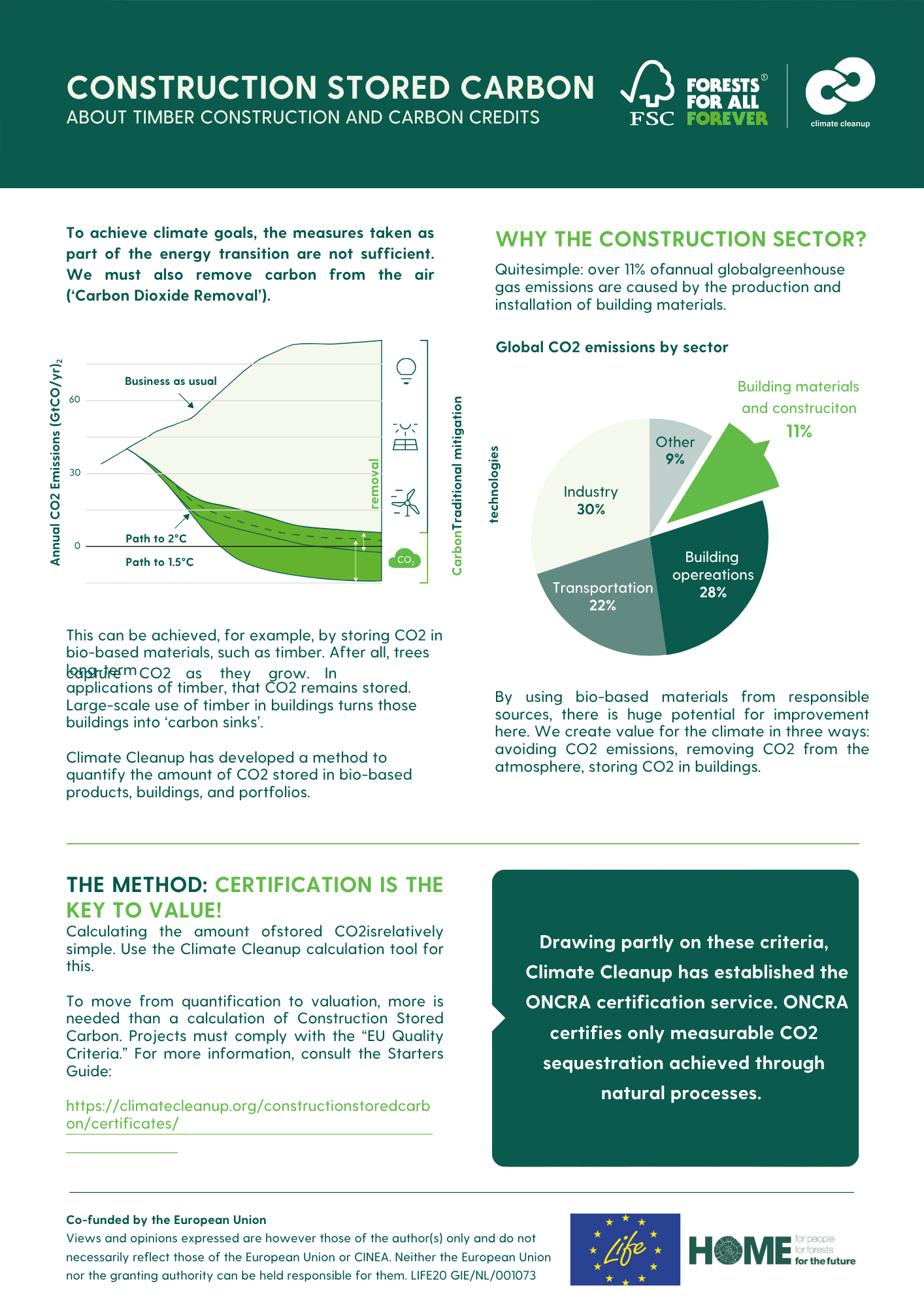
A timber building stores the carbon absorbed during the tree's growth for the lifetime of the structure. That storage is measurable, certifiable, and increasingly recognised under EU regulation. But most project teams do not yet know how to calculate it, value it, or report it.
This factsheet introduces the ONCRA certification system developed by Climate Cleanup, which verifies carbon storage through third-party validation and EU quality criteria. It explains how stored carbon can be quantified using a free online calculator, and how the resulting credits can be monetised, counted toward climate goals, or used to offset material costs.
A housing corporation in Alkmaar ran the calculation on a completed timber residential building. The result: 2,500 tonnes of CO₂ stored in a single project. The factsheet explains how that number was reached and what it means in practice.
With whole-life carbon disclosure becoming mandatory across the EU in 2028, project teams that understand this calculation now will be positioned to demonstrate climate performance from the moment that framework enters into force.
-
Developed by Climate Cleanup and FSC Netherlands in the context of the HOME for the future project. Climate Cleanup is a nonprofit organisation dedicated to accelerating nature-based carbon removal. The ONCRA certification service certifies only measurable CO₂ sequestration achieved through natural processes and aligns with the EU Carbon Removal Certification Framework. A free calculation tool is available via climatecleanup.org.
A timber building stores carbon. This factsheet explains how to measure it, certify it, and make it count financially.
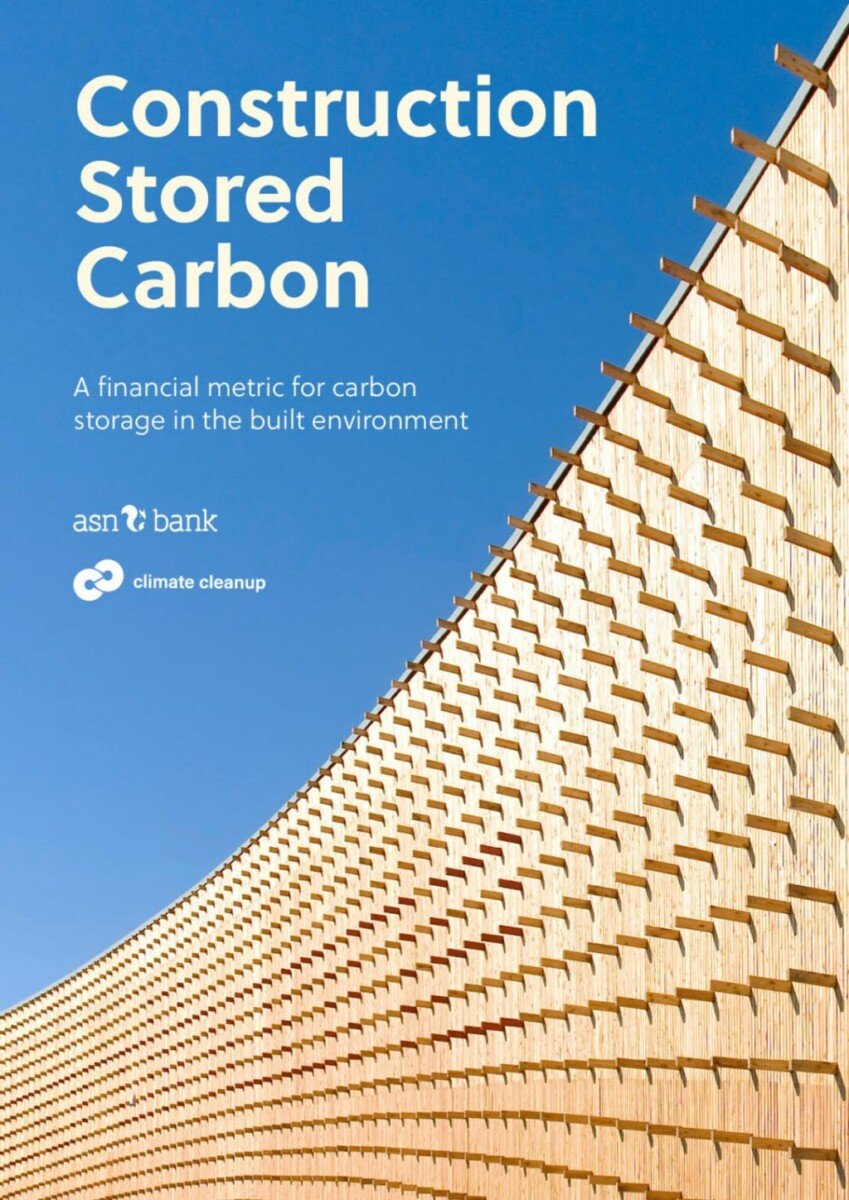
Construction Stored Carbon Protocol
-
This protocol sets out exactly how to certify the carbon stored in a biobased construction project, from the first design sketch to the completed building. It covers three stages: in design, under construction, and as built. At each stage, different rights apply: a completed design enables a validated calculation statement, a building permit enables provisional certification and pre-sale of up to 50% of carbon removal units, and a completed building enables full certification and sale of 100% of the generated units.
The protocol uses the Net Carbon Removal Benefit as its central metric: the carbon stored in eligible biobased products, minus a standard baseline for conventional construction. Timber structural elements with a minimum lifespan of 35 years are eligible. Products certified under FSC, PEFC or similar schemes meet the sustainability requirements.
For project teams and sustainability advisors who want to understand the full methodology before applying it, or who need to demonstrate compliance with the EU Carbon Removal Certification Framework.
-
Developed by Climate Cleanup Foundation and funded by Built by Nature and Good Energies Foundation. The protocol is aligned with the EU provisional agreement on a Union certification framework for carbon removals and follows the Open Natural Carbon Removal Accounting Guidelines. Version 1.0 was published on 31 May 2024 and is currently in public consultation.
The technical foundation for quantifying and certifying carbon storage in timber buildings
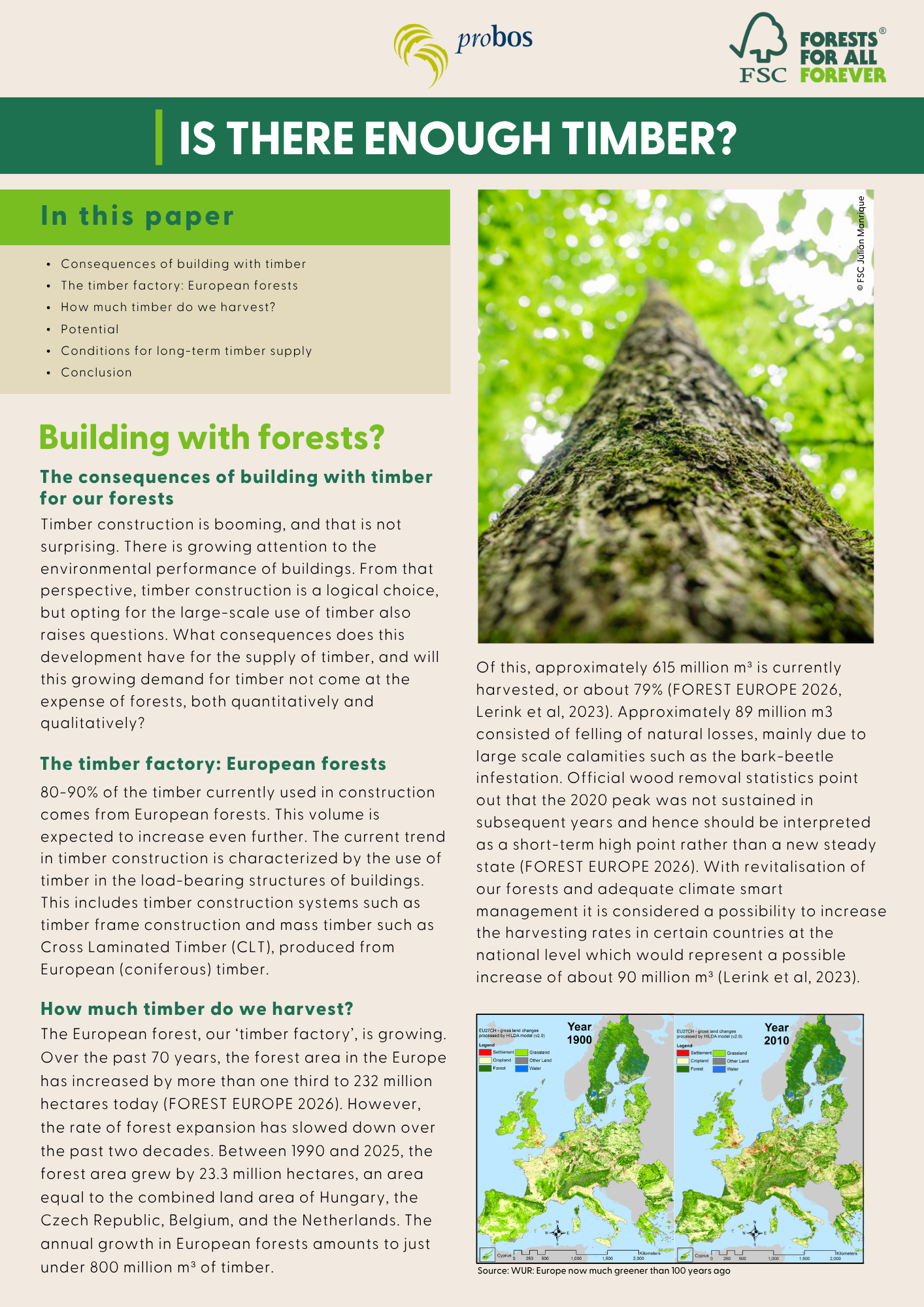
Is there enough timber?
-
Timber construction is growing fast. That raises a legitimate question: if the sector scales up, will there be enough timber, and what does that mean for forests?
The answer is more precise than the debate usually allows. European forests cover 232 million hectares today, up by more than a third over the past 70 years. Annual growth amounts to just under 800 million m³. Of that, approximately 615 million m³ is currently harvested. The forest is growing faster than it is being cut.
Probos calculated that sawn softwood consumption in the European construction sector will increase by approximately 21 million m³ by 2040. Around 14 million m³ of that can be covered by redirecting current exports to internal European consumption. The remaining volume requires an increase in harvesting of roughly 10%, which independent research considers realistic given current forest growth rates.
The more significant constraint is not volume but application. Large quantities of timber that are currently used for fuel and paper production have the quality to serve construction purposes. In the Netherlands alone, fuelwood production in 2024 was twice the volume of harvested industrial roundwood. Shifting those assortments toward higher-value construction use is the more immediate lever than planting new forests.
Three conditions determine whether long-term supply remains sustainable: forest management that prioritises high-value timber production, certification schemes that protect biodiversity and forest resilience, and circular design strategies that extend the useful life of timber through reuse and cascading. All three are available. None of them is automatically in place.
-
Developed by Probos, an independent research institute specialising in wood and forests, in the context of the HOME for the future project. The paper draws on data from Forest Europe 2026, Wageningen University research on timber harvesting potential, and sector statistics on wood use in the Netherlands and across Europe. The central question, whether scaling timber construction puts forests at risk, is addressed with current data rather than assumptions.
The most common objection to scaling timber construction, examined with current forestry data. European forests are growing. The real question is whether the right timber reaches the right applications, and under what conditions that remains the case at scale.

Train-the-Trainer Kit
Timber construction for housing corporations
-
Since 2022, more than 200 housing corporations have participated in the timber construction course developed by FSC Netherlands. The Train-the-Trainer Kit makes that same programme available to any organisation in Europe that wants to build timber construction knowledge within their own team.
The kit contains everything needed to deliver a full-day training independently: a comprehensive slide deck of over 100 slides covering the full curriculum, a trainer manual with facilitation guidance, group discussion exercises, and an icebreaker to gauge your audience from the start. The training is designed for 12 to 20 participants and built to surface the questions and hesitations that actually exist within a project team, not to lecture them.
The curriculum covers seven modules: why build with timber, construction techniques, architecture and wellbeing, tenant communication, rules and regulations, costs and total cost of ownership, and successful commissioning. All materials are fully adaptable to your country's regulations, policies, and construction practices.
-
Developed by FSC Netherlands in direct collaboration with nine Dutch housing corporations. The kit was built by and for the people who actually make timber construction decisions. FSC Netherlands offers free support to organisations in other EU countries that want to develop or adapt the training for their own context, whether that means reviewing adapted materials, providing additional sources, or connecting trainers with sector expertise.
A complete training programme, ready to adapt and deliver in your own organisation.

Discussing Timber Myths
-
Many of the assumptions that slow down timber construction in Europe are not based on evidence. They are based on habit, outdated information, and the absence of data in conversations where data would change the outcome.
This booklet examines twelve of the most persistent myths across four themes: building quality and performance, environment and climate, forestry and wood availability, and economics. Each myth is addressed with current research findings, followed by an open dialogue from an international steering group of experts on what the nuances and next steps actually are.
The findings are direct. Timber has one of the best strength-to-weight ratios of all building materials and can be used safely in high-rise construction. Mass timber chars predictably under fire, and fire safety can be engineered through well-established design measures. Indoor timber structures that remain dry can last indefinitely. European forests are growing, not shrinking. When an experienced team designs for timber from the outset, construction costs can be fully competitive with traditional methods.
What the booklet does not do is pretend these are simple questions. The steering group includes ecologists, engineers, architects, climate scientists, and policy experts from seven countries. Their disagreements are part of the publication. That makes it a more honest and more useful resource than a straightforward advocacy piece.
-
Developed by AMS Institute for Advanced Metropolitan Solutions, co-funded by Built by Nature. The international steering group includes contributors from TU Delft, Bauhaus Earth, the Potsdam Institute for Climate Impact Research, Edinburgh Napier University, Wageningen University, the University of Primorska, and IAAC Barcelona, among others. Pablo van der Lugt and Joke Dufourmont, both contributors to the HOME for the future project, are among the lead authors.
Twelve persistent misconceptions about timber construction, examined and countered with the latest research.

Architects for Forests
-
The sourcing decision starts with the architect. Material choices made at the design stage determine whether a building's climate performance can be verified, certified, and reported — and from 2028, whole-life carbon disclosure becomes mandatory across the EU. This magazine addresses that responsibility directly.
Wooden Wonders covers the case for FSC certification and what it verifies, the carbon performance of certified versus uncertified timber, prefabricated timber housing systems and their advantages for speed and quality, lesser-known tropical timber species and their applications in cladding and window framing, and the free Sustainable Building with Timber course developed by TU Delft.
It is free to read and download.
-
Developed by FSC in the context of the HOME for the future project. The 2026 edition includes updated LCA data, new EPDs for timber products, and expanded coverage of construction stored carbon and prefabrication systems.
A magazine for architects on responsible timber sourcing and what it means in practice.
Principles for Responsible Timber Construction
-
The publication Principles for Responsible Timber Construction by Built by Nature introduces a clear global framework for scaling timber construction in a responsible way. It sets out five principles that link the built environment, the use of biobased materials and sustainable forest management. The principles focus on extending the life of existing buildings, reducing whole life carbon, ensuring sustainable forest management, maximising long term carbon storage through efficient and reusable timber design and supporting a healthy biobased economy through knowledge, skills and innovation.
The framework was developed with input from experts, governments and practitioners and is intended to guide policy and market adoption. Organisations are invited to endorse the principles and apply them in their projects and strategies so that by 2030 responsible timber construction becomes a mainstream and well governed approach. -
Principles for Responsible Timber Construction is a framework published by Built by Nature that aims to provide a shared foundation for responsible timber construction worldwide. It brings together insights from the construction sector, forestry and research to define five practical principles that address design, carbon, resource use and forest stewardship.
The publication is designed to support decision makers in policy, development and construction who are working toward climate neutral and nature positive building. It offers a common reference point for public and private stakeholders who want to scale timber construction in a way that strengthens both the built environment and forest landscapes.
A shared language and global framework to ensure that growing demand for timber is managed responsibly while supporting forests and delivering benefits for climate, nature and people.

Tropische houtsoorten in woningbouw (NL)
-
Sta als opdrachtgever open voor de toepassing van andere tropische houtsoorten dan de gangbare. Dit geeft de FSC-bosbeheerder de mogelijkheid het bos nog evenwichtiger te beheren. In deze flyer staan enkele voorbeelden van de diversiteit aan houtsoorten die voor bepaalde toepassingen gebruikt kan worden.
In deze flyer staan enkele voorbeelden van de diversiteit aan houtsoorten die voor bepaalde toepassingen gebruikt kan worden

Houtbouw? Pak die kans als gemeente! (NL)
-
Gemeenten kunnen als opdrachtgever, verbinder en versneller een prominente rol spelen in het stimuleren van houtbouw. Dat is belangrijk, want bouwen met hout betekent invulling geven aan klimaatdoelen en circulaire ambities.
Sommige gemeenten zijn al volop aan de slag met houtbouw, anderen zitten nog in de oriëntatiefase. Die laatste groep bieden we dit pamflet met tips en handreikingen.
Een pamflet met tips en handreikingen voor gemeenten in de oriëntatiefase van houtbouw.
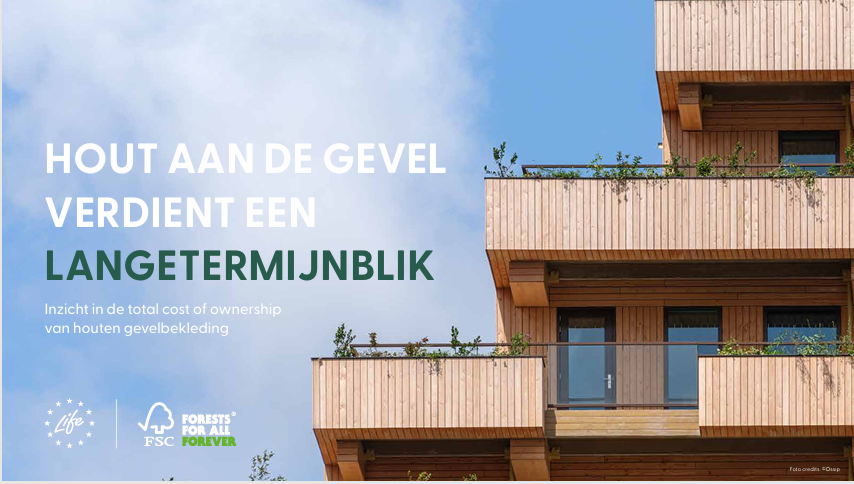
Hout aan de gevel verdient een langetermijnblik
-
Hout aan de gevel wint terrein, maar bij veel opdrachtgevers roept het nog vragen op. Hoeveel onderhoud vraagt het, hoe lang gaat het mee, en wat betekent dat voor de meerjarenonderhoudsbegroting.
Die vragen worden in de praktijk vaak beantwoord met een aanname of de ervaring van een vorig project. Begrijpelijk, maar riskant. Deze publicatie zet er cijfers tegenover. Vier veelgebruikte typen houten gevelbekleding worden over veertig jaar met elkaar vergeleken, op basis van praktijkgegevens van woningcorporaties.
De uitkomst is genuanceerd. Niet de laagste prijs per m², maar het aantal vervangingsmomenten bepaalt uiteindelijk wat een gevel kost. Een goedkope naaldhouten gevel die je twee keer vervangt, is duurder dan een tropische loofhouten gevel die veertig jaar blijft staan. Prijs per m² en werkelijke kosten wijzen lang niet altijd dezelfde kant op. Deze whitepaper legt dat naast elkaar, op basis van praktijkcijfers van woningcorporaties, zodat je ziet waar de kosten echt in gaan zitten.
-
Deze publicatie is opgesteld door FSC Nederland, binnen het Europese LIFE-project HOME for the future. Ze komt voort uit vragen die woningcorporaties de afgelopen jaren steeds opnieuw stelden tijdens cursussen en kennissessies over houtbouw. De TCO-analyse is gebaseerd op erkende normen, praktijkrichtlijnen en ervaringscijfers uit de sector, met bijdragen van houthandels, kennispartners en woningcorporaties, en een klankbordgroep met onder meer TBI, Houtbouw Lente en wrk architecten. Dit is deel 1. In deel 2, gepland voor 2027, komt de milieubelasting erbij in een true price-benadering, de integrale kostprijs inclusief materiaal- en milieu-impact.
Inzicht in de total cost of ownership van houten gevelbekleding

Construction Stored Carbon Factsheet (NL)
-
Een houten gebouw slaat de koolstof op die tijdens de groei van de boom is opgenomen, en dit gedurende de gehele levensduur van het bouwwerk. Die opslag is meetbaar, certificeerbaar en wordt steeds meer erkend in het kader van de EU-regelgeving. Maar de meeste projectteams weten nog niet hoe ze dit moeten berekenen, waarderen of rapporteren.
Deze factsheet introduceert het door Climate Cleanup ontwikkelde ONCRA-certificeringssysteem, dat koolstofopslag verifieert door middel van validatie door een onafhankelijke derde partij en op basis van EU-kwaliteitscriteria. Het legt uit hoe opgeslagen koolstof kan worden gekwantificeerd met behulp van een gratis online calculator, en hoe de daaruit voortvloeiende kredieten kunnen worden gemonetariseerd, meegeteld voor klimaatdoelstellingen of gebruikt om materiaalkosten te compenseren.
Een woningcorporatie in Alkmaar heeft de berekening uitgevoerd voor een voltooid woongebouw van hout. Het resultaat: 2.500 ton CO₂ opgeslagen in één enkel project. De factsheet legt uit hoe dat cijfer tot stand is gekomen en wat het in de praktijk betekent. beschrijving
This factsheet introduces the ONCRA certification system developed by Climate Cleanup, which verifies carbon storage through third-party validation and EU quality criteria. It explains how stored carbon can be quantified using a free online calculator, and how the resulting credits can be monetised, counted toward climate goals, or used to offset material costs.
A housing corporation in Alkmaar ran the calculation on a completed timber residential building. The result: 2,500 tonnes of CO₂ stored in a single project. The factsheet explains how that number was reached and what it means in practice. description
-
Deze factsheet is opgesteld in het kader van het project HOME for the future, in samenwerking met Climate Cleanup, een non-profitorganisatie die zich inzet voor het versnellen van natuurgebaseerde koolstofverwijdering. De EU-verordening inzake koolstofverwijdering en koolstoflandbouw, die in december 2024 is aangenomen, stelt het eerste Europese certificeringskader vast voor koolstofopslag in biogebaseerde bouwproducten. Voor 2026 staat een specifieke methodologie voor gebouwen op de planning. Projectteams die deze berekening nu al begrijpen, zullen in staat zijn om hun klimaatprestaties aan te tonen vanaf het moment dat dit kader van kracht wordt.
Een houten gebouw slaat koolstof op. In deze factsheet wordt uitgelegd hoe je dit kunt meten, certificeren en er financieel voordeel uit kunt halen.

The Wooden Dial
-
The Wooden Dial is a guide that explains and divides relatively complex building technical knowledge about the use of wood in new construction into steps from 0-5.
It is important to decide on any use of wood in new construction early in the planning phase, and with The Wooden Dial you can see how you can increase the amount of wood, step by step.
At the same time, the guide also shows the climatic and economic impact at each step. The Wooden Dial focuses on how to go a long way with sustainability, without necessarily making the construction process more expensive or complicated.
The guide is primarily to be used as a conversation starter early in the planning of a construction project, where the project group must lay out a strategy for how to achieve the greatest possible sustainability in the project. -
The Wooden Dial (Træbarometeret in Danish) was developed by Niels Toft Wendelboe, Byggepartnerskabet &os and KAB.
KAB is Denmark’s largest administrator of non-profit housing.
A guide to building with more wood in non-profit housing